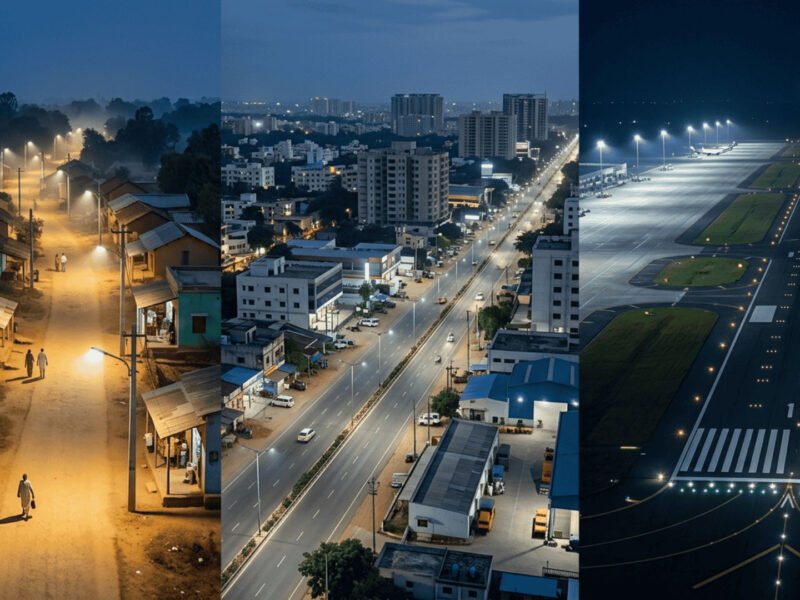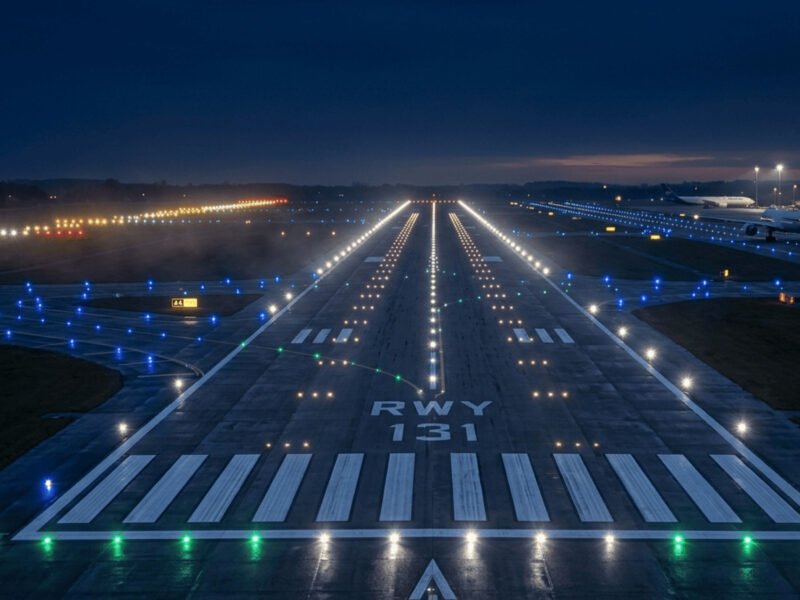


Night flying often feels calm from the passenger’s window seat, but the real work happens outside, where visibility depends almost entirely on artificial guidance. Pilots rely on a well-designed network of lights to judge distance, alignment, and depth – especially during landing and takeoff.
For anyone involved in airport operations across India, from Ahmedabad to smaller regional airfields, understanding how runway lighting systems support safe night operations is essential.
You’ll find that effective lighting is not just an ICAO requirement or a DGCA checklist item – it is a safety backbone. And with India’s aviation sector expanding rapidly, these systems matter more than ever.
Why Runway Lighting Matters More in India
Weather patterns in India add layers of complexity. A winter evening in Delhi can drop visibility to a few metres. Coastal cities like Mumbai or Chennai often deal with moisture-filled air that scatters light. Western regions such as Gujarat face months of dry dust, which can blur the horizon and make night visuals deceptive.
Even a perfectly trained pilot cannot overcome poor visual cues. That’s why airports – from major hubs to new UDAN-route terminals – depend heavily on structured lighting.
The moment natural light disappears, the runway environment must be recreated by technology, and that technology must be consistent, bright, and dependable.
Modern LED runway lights improve this consistency. They deliver sharper illumination, keep intensity stable, and maintain clarity in environments where old halogen lamps struggle.
How a Pilot Sees the Airfield at Night
Pilots don’t see the airport the way we do from the terminal windows. Their first visual contact is usually a faint pattern of lights on the horizon. As they descend, that pattern grows into a structured layout that guides every decision.
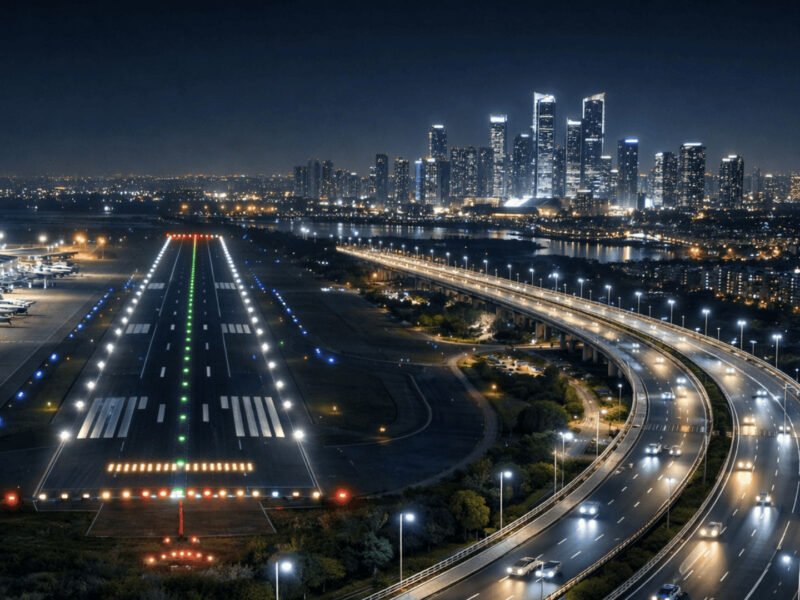
During a night approach into Ahmedabad, for instance, the glow of the city surrounds the airfield. Without well-calibrated airport lighting solutions, distinguishing runway edges from street lights would be difficult. Light pollution can mask visual cues, especially when atmospheric haze spreads glow across the sky.
Good runway lighting cuts through that clutter. It gives the pilot a clean reference frame, almost like tracing a straight line across a noisy background.
Approach Phase: The First Visual Anchor
The approach lighting system is the pilot’s first assurance that alignment is correct. These lights extend outward from the runway and help the pilot commit to the glide path.
Approach lighting joins the instrument landing system to form a continuous chain of information. Even if the pilot is on autopilot during most of the descent, the transition to manual handling begins with these lights.
When visibility drops, their intensity matters even more. LED-based systems maintain colour purity and contrast, allowing the pilot to quickly judge:
-
The exact alignment
-
The slope of descent
-
The distance to threshold
Old halogen lamps often fade, warm up slowly, and lose uniformity. LEDs maintain brightness even during long hours of operation.
Crossing the Threshold: The Most Critical Moment
The threshold is not just the starting line of the runway – it’s the point where two worlds meet: the world of controlled flight and the world of ground handling.
Threshold lights, glowing green toward the pilot, confirm the safe landing zone. REILs – Runway End Identifier Lights – add flashing guidance that helps the pilot orient instantly during low visibility.
In an airport surrounded by city lighting, a pilot can easily misjudge runway boundaries. Sharp LED lighting removes the guesswork.
This small reassurance at the threshold goes a long way in reducing the chances of early touchdown or runway undershoot.
Touchdown Zone: Fine Judgement Under Pressure
Landing is one of the most demanding phases in flying. At night, pilots rely heavily on runway centerline and edge lights to maintain direction.
Touchdown zone lights help them estimate height and distance during the flare – the split-second moment when the aircraft transitions from flying to rolling.
Pilots often describe the flare at night as “flying into a window of lights.” The clearer this window is, the smoother the landing.
LED lights help here because:
-
Their colour does not shift as they warm
-
They don’t flicker
-
They maintain consistent intensity across the runway
This uniformity makes it easier for pilots to judge lateral and vertical alignment.
Rollout: Staying Centered in the Dark
Runway excursions often occur during the rollout, not the landing itself. Strong crosswinds, wet surfaces, or uneven visibility can cause slight deviations that grow quickly.
Centerline lights give pilots a visual spine to follow. Edge lights help them judge distance from the boundaries.
LED-based runway lighting systems offer better contrast even during heavy rain, a common scenario in Mumbai or Kochi. Halogen lights tend to blur under water film; LEDs cut through reflection and maintain shape.
This clarity reduces the cognitive load on pilots, especially when they’re managing deceleration, thrust reversers, and directional control all at once.
Taxiing: The Often Overlooked Part of Night Safety
Taxiing seems simple, but airports are busy places with complex layouts. At night, it can feel like navigating a maze without the daylight advantage.
Taxiway lighting solutions – blue edge lights and green centerline lights – become essential.
They guide the aircraft from runway to apron safely by defining:
-
Holding positions
-
Intersections
-
Turning radii
-
Safe distances from other aircraft
In airports where taxiways intersect multiple times or where expansion projects create temporary diversions, LED taxiway lights offer crisp guidance without confusing glare.
Why LED Airport Lighting Is Transforming Indian Runways
Airports across India are replacing older fittings with LED airport lighting for several reasons. The benefits go beyond brightness.
Energy Efficiency That Matters
Electricity demand in large airports is enormous. LEDs cut consumption significantly, allowing airports to channel savings into safety upgrades or terminal improvements.
Longer Service Life
Reducing maintenance cycles means fewer runway closures. Even a 10-minute closure affects schedules.
LEDs stay stable for years, reducing interruptions.
Better for Harsh Indian Conditions
India’s climate demands durability:
-
Intense heat in the West
-
Heavy rainfall in the South
-
Fog in the North
-
Dust in Central and Western regions
LEDs handle all of these better than older lamps.
Sharper, Cleaner Light
Pilots report that LEDs produce a more “readable” environment. Colours remain true and avoid the warm-yellow tint associated with halogens.
The shift to LED lighting might seem like a technical upgrade, but its impact is deeply operational. Pilots notice the difference immediately. Ground crews appreciate the reliability. Airport managers see fewer disruptions. And passengers experience smoother arrivals even when visibility is low.
Where LED Runway Lights Make the Most Measurable Difference
Some improvements are obvious, like the brightness and clarity LEDs offer. Others are subtle but equally important.
Improved Visual Contrast During Monsoons
Heavy rain causes a thin sheet of water to form on the runway surface. Halogen lights often scatter on this layer, making the beam appear blurred.
LED runway lights cut through rain with better directionality. The defined beam edges help pilots maintain the centerline even when the surface is glossy.
This is particularly useful in cities like Mumbai, Mangalore and Goa where monsoon rainfall is intense.
Stable Illumination When Power Grids Fluctuate
Indian airports sometimes deal with voltage variations, especially in regions with older power networks. LEDs tolerate these fluctuations better and maintain consistent brightness.
For pilots, this means predictable lighting every time they approach the airfield.
Sharper Lighting in Hazy Western India
Gujarat, Rajasthan and parts of Maharashtra experience long dry periods where dust remains suspended in the air. In such conditions, scattered light can create halos around halogen fittings.
LEDs retain sharpness, making visual cues clearer for pilots arriving into airports like Ahmedabad, Surat or Rajkot.
Better Integration with Modern Control Systems
Many airports are deploying advanced Airfield Lighting Control and Monitoring Systems. LEDs integrate more smoothly because they respond instantly to intensity changes.
This helps controllers manage lighting levels based on ambient conditions without dealing with slow warm-up times.
Night Operations: Real-world Flight Scenarios in India
A runway lighting system proves its worth during challenging moments. Here are a few real-world examples from typical night operations.
A Short Final Approach in Low Visibility
Imagine a pilot approaching Ahmedabad on a winter night when shallow fog settles close to the ground. The approach lights break through the haze and help the pilot establish alignment early.
Threshold lights confirm the exact landing point, and centerline lights guide the aircraft through the final seconds of descent.
Each visual element contributes to one smooth decision: continue landing safely.
Taxiing at a Busy Airport with Multiple Intersections
Large airports like Delhi or Bengaluru have complex taxiway layouts. At night, identifying the correct route requires clear visual markers.
Well-designed taxiway lighting helps pilots avoid wrong turns and prevents runway incursions, which are among the most serious ground incidents.
Landing During a Heavy Downpour
Rain can distort depth perception. Pilots rely on the sharp definition of LED runway lighting systems to avoid drifting sideways or touching down off-centre.
Touchdown zone lighting provides the depth cues needed to judge the flare precisely.
These situations illustrate how lighting isn’t just a regulatory necessity – it is an operational safeguard.
Expert Guidance for Airport Teams Planning Upgrades
Airport operators often ask what factors matter most when transitioning to modern lighting. Based on field experience, a few considerations stand out.
Evaluate Local Weather Conditions First
Weather greatly influences lighting performance. If an airport experiences fog, humidity, dust storms or heavy rainfall, the system must be chosen accordingly.
LED lighting offers flexibility through adjustable intensity and sharp beam patterns.
Ensure Strong Compliance Awareness
Runway and taxiway lighting must meet ICAO Annex 14 standards.
Airports planning upgrades should align early with DGCA guidelines to avoid retrofitting later.
Plan for Future Expansion
India’s aviation infrastructure is evolving fast. A lighting system installed today should fit into tomorrow’s taxiway extensions, new terminals, or approach upgrades.
LED-based airport lighting solutions are modular and adapt well to expansion.
Consider Maintenance Practicalities
Airports benefit from reducing closures caused by maintenance. LEDs minimise these interruptions.
Their long service life ensures fewer replacements, which is an operational advantage during peak hours.
Think About Energy Management
LED airport lighting significantly reduces power use. For airports operating under tight budgets or sustainability goals, this becomes a decisive factor.
How Lighting Enhances Overall Airport Efficiency
It’s easy to focus only on the runway, but improved lighting creates ripple effects throughout airport operations.
Controllers gain confidence when they know the airfield is well illuminated.
Pilots experience less stress, especially during adverse weather.
Ground staff work in safer surroundings where markings and boundaries are visible.
Airlines benefit from fewer delays caused by visibility issues.
Passengers experience more reliable schedules.
In a country where aviation demand continues to rise, these small improvements add up to a more resilient network of airports.
FAQ
What do runway lighting systems do?
They guide pilots during landing, takeoff and taxiing at night or in low visibility. Lights mark runway boundaries, centerline, threshold and approach direction.
Why are LED runway lights preferred?
They provide clearer illumination, use less energy, and last longer. LEDs perform better during rain, fog and dusty conditions common in many Indian regions.
Are Indian airports switching to LED airport lighting?
Yes. Many airports across India – including those in Gujarat, Maharashtra and southern states – are adopting LED-based systems for better performance and efficiency.
What are taxiway lighting solutions used for?
They help pilots navigate between runways and terminals safely, reducing the risk of wrong turns or runway incursions during night operations.
Do runway lights improve landing safety?
Yes. They offer visual cues that help pilots judge alignment, distance and height during touchdown, especially when natural visibility is limited.
Lighting That Supports India’s Growing Aviation Landscape
Runway lighting doesn’t often make headlines, yet it carries enormous responsibility.
Every smooth touchdown after sunset and every safe departure in low visibility reflects the reliability of this system. As India modernises airports across its states, especially in regions like Gujarat and other emerging hubs, the value of dependable lighting becomes clearer.
LED runway lights systems and modern airport lighting solutions offer precision, stability and resilience that older systems cannot match. They support pilots, reduce operational disruptions and enhance safety across the airfield.
For airports planning upgrades or exploring new installations, Nessa, based in Ahmedabad, offers advanced LED lighting designed for India’s aviation environment. Their solutions focus on efficiency, compliance and long-term reliability – qualities every airport depends on.