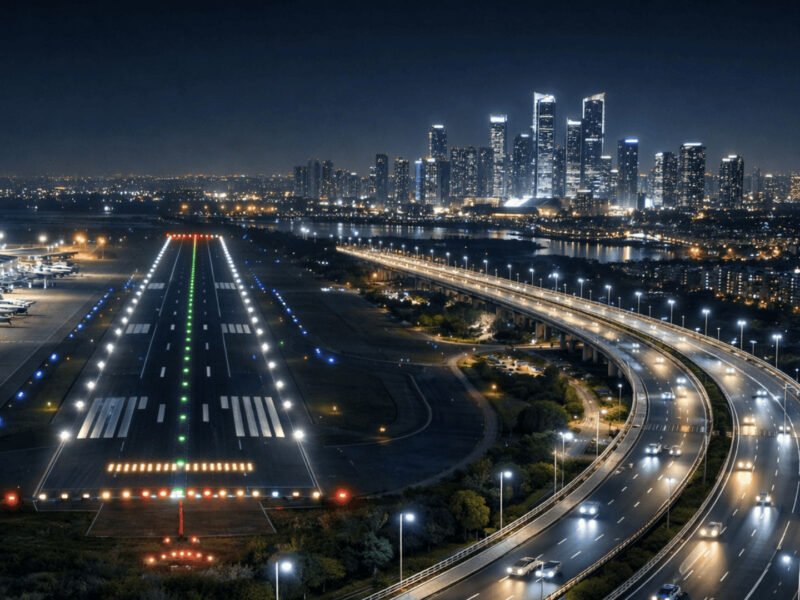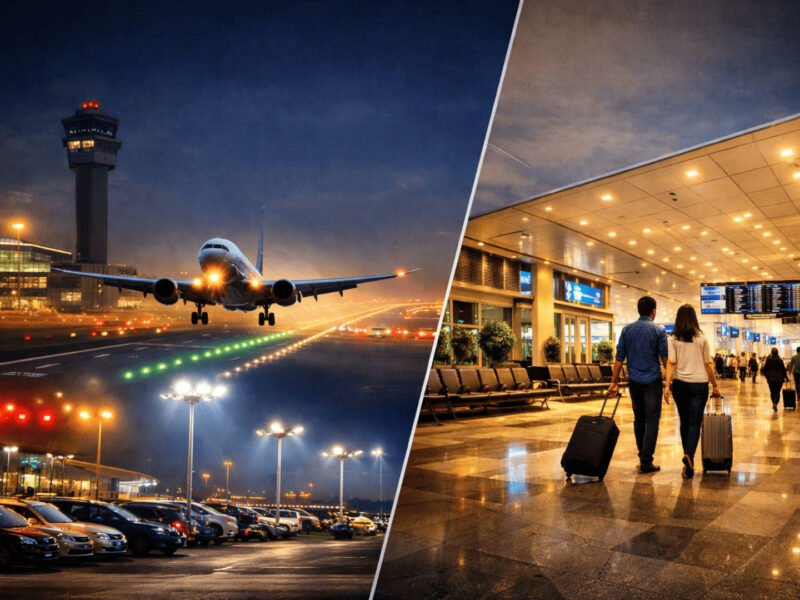

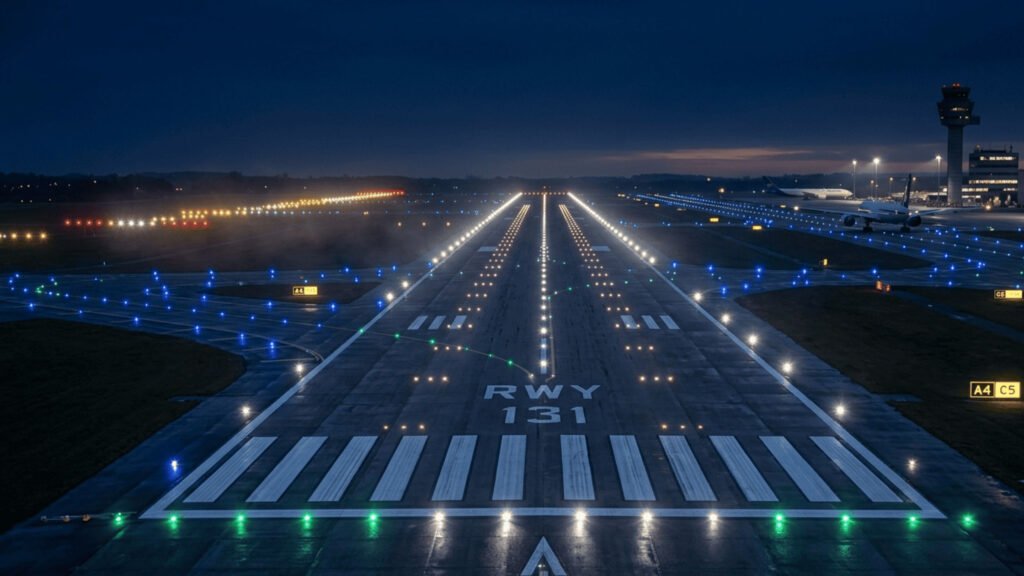
Safe aviation depends on visibility. From the moment a pilot begins final approach to the moment an aircraft parks at the gate, a continuous chain of precisely positioned lights guides every movement – on the runway, along taxiways, across the apron, and around the perimeter. These are not ordinary lights. They are a safety-critical, regulatory-governed system known collectively as airport lighting solutions or airfield ground lighting (AGL).
This guide covers every major component of modern airport lighting: the types, functions, technologies, regulatory standards, and the decisions airport operators and engineers must make when planning new installations or upgrading existing systems.
What Are Airport Lighting Solutions?
Airport lighting solutions are the integrated set of visual aids installed at an aerodrome to support safe aircraft movement during night operations, low-visibility conditions, and instrument approaches. They communicate critical information – runway boundaries, approach paths, taxiway routing, obstacle locations – through precisely controlled light color, intensity, and position.
Airfield ground lighting operates across two broad environments:
Movement area lighting guides aircraft while in motion – during approach, landing, taxiing, and takeoff. This includes runway edge lights, approach lighting systems, taxiway centerline lights, and stop bars.
Non-movement area lighting covers areas where aircraft are stationary or handled by ground crews, primarily apron floodlighting and gate area lighting.
Every element of an airport’s lighting system must comply with regulatory standards – principally the FAA’s Advisory Circulars in the United States, and ICAO Annex 14 for international operations.
Types of Airport Lighting Systems
1. Runway Lighting
Runway lights are the backbone of airfield ground lighting. They define the boundaries of the operative landing surface and guide pilots through takeoff and landing in reduced visibility.
Runway Edge Lights mark the lateral limits of the runway. They are classified by intensity: High Intensity Runway Lights (HIRL), Medium Intensity Runway Lights (MIRL), and Low Intensity Runway Lights (LIRL). Edge lights are white along the runway, transitioning to yellow in the last 2,000 feet (or half the runway length, whichever is less) to signal the runway’s remaining distance.
Runway Threshold Lights are green and mark the beginning of the usable landing area. They are unidirectional, visible only on approach.
Runway End Lights are red, marking the far end of the runway. They are paired with green threshold lights as bidirectional fixtures, so a single fixture unit serves both functions depending on direction of view.
Runway Centerline Lights (RCLL) are inset into the pavement along the runway’s centerline. They are white in the approach zone, alternating red and white in the final 3,000 feet, and solid red in the final 1,000 feet – a progressive warning system to signal to the pilot that they are running out of runway.
Touchdown Zone Lights (TDZL) are white inset lights on both sides of the centerline in the first 3,000 feet of the landing surface, helping pilots maintain alignment at the moment of contact.
Runway End Identifier Lights (REIL) are synchronized flashing lights positioned laterally on each side of the runway threshold. They allow fast, positive identification of the runway approach end, particularly valuable at busy airports where the runway is surrounded by competing light sources.
Runway Guard Lights are flashing amber lights installed at taxiway/runway intersections, providing a visible alert to pilots and vehicle operators that they are approaching an active runway. They are a key tool in reducing runway incursion risk.
2. Approach Lighting Systems (ALS)
Approach lighting systems extend the visual guidance beyond the runway threshold, allowing pilots to transition from instrument flight to visual flight during the final phase of landing. These are among the most complex and important systems at any Category II or III airport.
Common configurations include:
-
ALSF-1 and ALSF-2 (Approach Lighting System with Sequenced Flashing Lights): High-intensity systems for Category I, II, and III operations
-
MALSR (Medium-Intensity Approach Lighting System with RAIL): For Category I approaches
-
MALS and ODALS for non-precision approaches at smaller airports
Sequenced flashing lights in these systems fire in rapid sequence from threshold outward, creating a visible “rabbit” effect that draws pilots’ eyes toward the runway on final approach in low visibility.
3. Precision Approach Path Indicators (PAPI)
PAPI lights are among the most operationally critical visual aids on any runway. They provide pilots with real-time feedback on whether their approach angle is too high, too low, or correct.
A standard PAPI installation consists of four light units positioned to the left of the runway. Each unit projects a bicolor light – red below a set angle, white above it. The combination of red and white lights visible to the pilot indicates their approach path:
-
4 white lights – too high
-
3 white, 1 red – slightly high
-
2 white, 2 red – on correct glide path
-
1 white, 3 red – slightly low
-
4 red lights – dangerously low
PAPI lights are available in halogen and increasingly in LED formats. Solar-powered LED PAPI systems have become a practical solution for remote or off-grid runways, providing full ICAO-compliant approach path guidance without grid power.
4. Taxiway Lighting
Once an aircraft lands, taxiway lighting takes over to guide safe ground movement from the runway to the terminal or parking area.
Taxiway Edge Lights are blue – a universal color standard that distinguishes taxiways from runways at a glance. They define the edges of the taxiway surface.
Taxiway Centerline Lights are green inset lights that mark the centerline of the taxiway. During low-visibility operations, pilots follow green centerline lights to navigate the ground surface safely.
Stop Bar Lights are red inset lights across the full taxiway width at intersections with active runways. When illuminated, they represent an absolute stop signal – equivalent to a red traffic light for aircraft. The controlled activation of stop bars by air traffic control is one of the primary defenses against runway incursions.
Clearance Bar Lights are three in-pavement amber lights installed at taxiway holding positions, providing additional visual emphasis of the hold point.
Lead-On and Lead-Off Lights guide aircraft turning from taxiway to runway and runway to taxiway, creating a continuous centerline arc through the turn.
5. Apron and Terminal Area Lighting
The apron is where aircraft park, are refueled, boarded, and serviced. Lighting here must be high intensity, uniform, and carefully designed to eliminate glare that could affect pilots taxiing nearby or ground crews working under and around aircraft.
Apron floodlighting typically uses high-mast tower-mounted LED floodlights, positioned and angled to deliver uniform illumination across gate areas, taxi lanes, and Remain Over Night (RON) parking. Good apron lighting design minimizes shadows and hot spots while preventing upward or horizontal light spill that creates hazards.
Interior terminal lighting is a separate design challenge, requiring high-quality illumination at security checkpoints, check-in counters, customs and passport control, and passenger concourses – each area with its own functional and comfort requirements.
6. Obstruction Lighting
Any structure on or near an airport that could be a hazard to aircraft must be marked with obstruction lighting. This includes:
-
Communication towers and antenna masts
-
Wind turbines within or near the approach corridor
-
Construction cranes and temporary structures
-
Elevated terrain features in approach paths
Obstruction lights are classified by intensity: Low Intensity (L-810), Medium Intensity (L-864/L-865), and High Intensity (L-856). Red steady or flashing lights are used at night; white flashing lights are required during daylight hours for tall structures.
Solar-powered obstruction lights have become widely adopted, particularly for remote towers, wind farms, and tall structures where grid connection is impractical. Systems designed to FAA and ICAO standards can operate continuously for multiple days without solar recharge – essential for extended overcast conditions.
7. Helipad Lighting
Heliports and hospital rooftop helipads require dedicated lighting systems distinct from fixed-wing runway lighting. Helipad lighting typically includes:
-
Perimeter lights defining the landing pad boundary (typically green)
-
Floodlights for surface illumination
-
Approach and departure path indicators (HAPI or similar)
-
Touchdown point illumination
Solar-powered helipad lighting is a popular solution for offshore platforms, mountain rescue sites, and hospital rooftops where grid power is unavailable or installation is complex.
LED vs. Traditional Halogen Airfield Lighting
The airfield lighting industry has undergone a substantial shift toward LED technology over the past decade, driven by measurable operational advantages.
According to industry data, LED airfield lighting now accounts for nearly 68% of installations at airports worldwide. The lifecycle cost advantage is significant: lower energy bills, fewer lamp replacements, and reduced runway closures for maintenance combine to deliver substantial savings over a 10–15 year system lifespan.
LED technology also supports dimming and intensity control more precisely than halogen systems, enabling adaptive lighting that reduces energy use during periods of low activity while maintaining full capability when needed.
Solar Airfield Lighting: When and Why
Solar-powered airfield ground lighting has evolved from a niche product for remote airstrips into a mainstream option used at commercial airports, military installations, and humanitarian operations worldwide.
When solar is the right choice:
-
Remote airports without reliable grid power
-
Temporary or portable runway lighting during construction or emergencies
-
Rapidly deployable expeditionary airfields
-
Locations where trenching for cable is impractical or cost-prohibitive
-
Airports seeking to reduce carbon footprint and energy costs
A solar airfield lighting system typically consists of self-contained units, each with an integrated or separately mounted solar panel, battery storage (capable of operating for 48–100 hours without recharge at maximum intensity), and a wireless or radio control interface. Modern systems are compliant with FAA Advisory Circulars and ICAO Annex 14 standards.
The key advantage for construction projects is zero-cable installation. At Lawton–Fort Sill Regional Airport in Oklahoma, solar LED runway lights allowed a major runway rehabilitation to proceed without closing the airport – runway lighting was installed rapidly without trenching, maintaining full operations throughout the project.
For permanent applications at remote aerodromes, solar AGL is often the only viable option, making it particularly prevalent in island airports, sub-Saharan Africa, and mountain airfields across South and Southeast Asia.
Smart Airfield Lighting Control Systems (ALCMS)
An Airport Lighting Control and Monitoring System (ALCMS) is the intelligence layer that unifies a modern airfield’s lighting infrastructure. Rather than managing circuits manually, ALCMS platforms allow air traffic controllers and airfield operations staff to:
-
Activate and deactivate individual lighting circuits from a central interface
-
Adjust intensity levels across zones (5 standard steps per FAA spec, typically 3–100% intensity)
-
Monitor real-time status of individual circuit elements and detect faults
-
Integrate lighting response with surface movement radar and ADS-B data
-
Log activation and fault history for maintenance and compliance records
The latest generation of adaptive lighting systems goes further. Companies like ADB SAFEGATE have introduced ADAL (Adaptive Lighting) fixtures that respond to real-time airfield conditions – adjusting pattern, intensity, and behavior based on aircraft position, weather sensor data, and operational scenario. Honeywell’s AI-driven control platform, launched in 2024, automates illumination based on aircraft movement patterns, reducing manual inputs by more than 50%.
Pilot-controlled lighting (PCL) is a related system that allows pilots to activate runway lights remotely by keying their radio transmitter at designated frequencies. This is widely deployed at uncontrolled airports and during off-hours when tower staffing is reduced.
FAA vs. ICAO Standards: What Operators Need to Know
Airport lighting systems must comply with the regulatory standards applicable to the aerodrome’s operations. The two dominant frameworks are:
FAA (Federal Aviation Administration) standards apply to airports within the United States. Key regulatory documents include:
-
Advisory Circular 150/5340-30 (Design and Installation Details for Airport Visual Aids)
-
Advisory Circular 150/5345 series (product-specific specifications for lights, signs, regulators, and control systems)
ICAO (International Civil Aviation Organization) Annex 14 governs international aerodromes and is the reference standard for airports outside the US or those serving international traffic. Most ICAO-compliant products are also FAA-certifiable and vice versa, but there are specification differences – particularly in photometric requirements, circuit voltage, and fixture dimensions.
For airports operating both domestic and international flights, procurement teams should confirm that products carry dual FAA/ICAO compliance. Many leading manufacturers design their current product lines for dual compliance to simplify international procurement.
Airfield Lighting Categories: CAT I, II, and III Explained
The approach and runway lighting requirements at an airport are directly tied to its instrument approach category, which determines the minimum visibility conditions under which landings are permitted.
Category I (CAT I): Decision height of 200 feet, with runway visual range (RVR) of at least 550 meters. Requires runway edge lights, threshold lights, end lights, approach lights (ALSF or MALSR), and PAPI.
Category II (CAT II): Decision height of 100 feet, RVR at least 300 meters. Requires all CAT I equipment plus runway centerline lights, touchdown zone lights, and more complex approach lighting.
Category III (CAT III): Decision height of less than 100 feet (or no decision height), with RVR as low as 75 meters (CAT IIIc allows operations in near-zero visibility). Requires the full suite of inset lighting, stop bars, lead-on/lead-off systems, and highly reliable ALCMS integration.
Upgrading an airport’s lighting infrastructure from CAT I to CAT II or III is a major project requiring not only new fixture installations but often substantial electrical system upgrades and FAA/ICAO certification processes.
Airport Lighting Market: 2026 Trends
The global airport lighting market was valued at approximately USD 0.79 billion in 2024 and is projected to grow to USD 1.38 billion by 2034, at a compound annual growth rate of 6.9%.
Key drivers shaping the market in 2026:
-
LED adoption acceleration: Nearly 68% of airports globally have adopted LED-based airfield lighting, up significantly from just a few years ago.
-
Solar growth: Solar lighting now accounts for approximately 26% of new installations, concentrated in emerging markets and remote airstrips.
-
Smart lighting control: A 41% rise in intelligent control system deployments reflects the push toward integrated, data-driven airfield management.
-
Retrofit demand: Aging halogen systems at mid-tier airports are driving a significant retrofit market as operators seek energy savings and reduced maintenance burden.
-
Sustainability mandates: Environmental commitments from aviation authorities and airport operators are accelerating the shift to energy-efficient technologies.
How to Choose the Right Airport Lighting Solution: A Buying Framework
Selecting airfield lighting requires balancing regulatory compliance, operational requirements, lifecycle costs, and installation constraints. Here is a practical framework for procurement and engineering teams:
Step 1 – Define the operational category. What instrument approach category does the runway support (or aspire to)? This determines the minimum lighting system requirements.
Step 2 – Assess power availability. Is reliable grid power available at the airfield? If not, solar or hybrid solar/grid systems should be evaluated. For temporary operations, portable solar lighting is often the fastest and most cost-effective solution.
Step 3 – Evaluate technology format. For most permanent installations, LED is the default choice. Confirm that products carry the applicable FAA (L-series) and/or ICAO certifications.
Step 4 – Plan for control and monitoring. Even at smaller airports, an ALCMS provides operational and safety benefits that justify the investment. Confirm that the control system integrates with existing electrical infrastructure.
Step 5 – Consider lifecycle cost, not just purchase price. A higher upfront investment in LED technology typically returns full cost recovery within 3–7 years through energy savings and reduced maintenance, depending on lamp hours and electricity costs.
Step 6 – Verify support and spare parts availability. Airport lighting systems must be maintainable on a 24/7/365 basis. Confirm that the selected manufacturer or distributor offers rapid parts availability and technical support.
Step 7 – Plan for future upgrades. The airfield lighting systems you install today should be compatible with future smart control integration, intensity adjustment, and potential category upgrades.
FAQ: Airport Lighting Solutions
What is the difference between airfield lighting and airport lighting?
The terms are often used interchangeably. “Airfield lighting” or “airfield ground lighting (AGL)” typically refers specifically to the lights on the operational surface – runways, taxiways, and aprons. “Airport lighting” is a broader term that can include terminal interior lighting, parking structures, and perimeter security lighting in addition to AGL systems.
What color are runway edge lights?
Runway edge lights are white along the majority of the runway, transitioning to yellow in the last 2,000 feet before the runway end. This yellow zone signals to pilots that they are entering the final portion of the available surface.
What are PAPI lights and how do they work?
PAPI (Precision Approach Path Indicator) lights are a set of four bicolor lights positioned to the side of the runway threshold. They display combinations of red and white to indicate whether the approaching aircraft is above, below, or on the correct glide path. Two white and two red lights indicate the correct approach angle.
Can airfield lighting operate on solar power?
Yes. Modern solar airfield lighting systems are available for runway edge lights, threshold lights, taxiway lights, PAPI, REIL, obstruction lights, and helipad systems. FAA-certified and ICAO-compliant solar systems can operate for 48–100 hours without solar recharge, providing reliable performance even in overcast conditions.
What is an ALCMS?
An Airport Lighting Control and Monitoring System (ALCMS) is the centralized control and monitoring platform for airfield ground lighting. It allows operators to activate and deactivate lighting circuits, adjust intensity, monitor fault status in real time, and integrate lighting with other airfield management systems.
What is the difference between CAT I, CAT II, and CAT III airport lighting?
The categories refer to the instrument approach certification of a runway. CAT I supports approaches down to 200 feet decision height and 550m RVR. CAT II goes to 100 feet and 300m RVR. CAT III permits approaches in near-zero visibility and requires the most comprehensive lighting infrastructure, including full inset runway lighting, stop bars, and advanced control systems.
What is the FAA L-series for airport lighting?
The FAA L-series designations are specification codes for certified airfield lighting equipment. For example, L-810 is the specification for low-intensity obstruction lights, L-858 covers airfield guidance signs, and L-890 covers airport lighting control and monitoring systems. Purchasing L-series certified products ensures FAA compliance for airports within the US.
How long do LED airfield lights last?
High-quality LED airfield fixtures are rated for 50,000+ hours of operation – compared to 500–1,000 hours for halogen lamps. In typical airfield use (operating approximately 4,000 hours per year), this translates to more than 12 years of lamp life before replacement.
Conclusion: Illuminate Every Landing with Confidence
Airport lighting is not a commodity purchase – it is a safety decision. Every runway edge light, every stop bar, every PAPI unit is a link in a chain that protects aircraft, crew, and passengers during the most critical phases of flight. When that chain is strong, pilots land with confidence. When it fails, the consequences can be irreversible.
The good news is that the technology available today is the best it has ever been. LED systems deliver five decades of reliable light output with a fraction of the energy consumed by legacy halogen fixtures. Solar-powered airfield lighting has made FAA and ICAO-compliant operations possible at remote and off-grid aerodromes across the country. Smart control systems give airfield operators real-time visibility into every circuit on the field. And sustainability goals that once seemed at odds with aviation infrastructure are now entirely achievable.
At Nessa, we bring over a decade of specialized LED and solar lighting expertise to the unique demands of airport and airfield environments. Our airport lighting solutions are engineered for the harshest operational conditions – extreme temperatures, continuous duty cycles, and zero tolerance for failure – backed by the same thermal management and driver reliability technology trusted by Adani, BHEL, ONGC, and leading aviation authorities across India.
Whether you are upgrading an existing airfield from halogen to LED, planning a new solar-powered runway lighting system for a remote aerodrome, or seeking an end-to-end apron and terminal lighting partner, Nessa has the engineering depth and manufacturing capability to deliver.
Ready to upgrade your airport lighting infrastructure? Explore Nessa’s Airport Lighting Solutions →