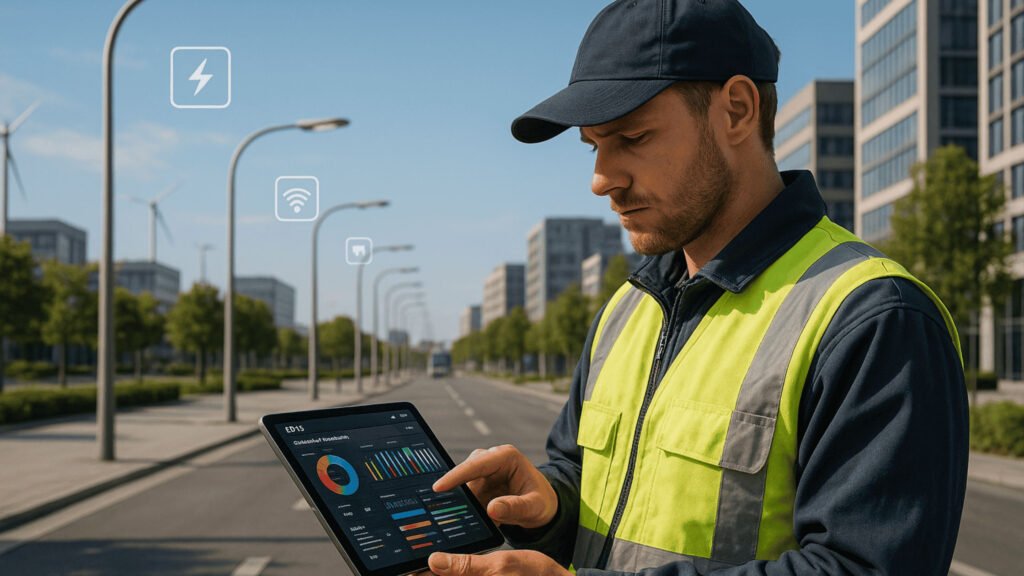
Keeping lights running may look simple from outside. But when you manage thousands of street lights, solar poles, or industrial lighting across a city or factory, the real challenges appear. A single failed light on a highway creates safety issues. A sudden voltage drop can damage equipment. A missed maintenance cycle increases costs.
This is where RMS remote monitoring systems have changed the game.
At Nessa, we work with government bodies, industries, builders, and EPC companies across India. And almost every customer we meet has the same question:
“How do we track our lighting assets without sending technicians everywhere?”
The answer is simple:
Remote monitoring, real-time alerts, and data-driven control.
This blog explains everything in a simple, everyday tone — how RMS works, why it is becoming essential in India, and who should invest in it today.
What Is an RMS Remote Monitoring System?
An RMS remote monitoring system is a connected platform that lets you track, control, and manage devices from anywhere. Think of it as a digital dashboard for all your lighting assets. It shows the health, performance, power consumption, and working status of every unit.
If you have 500 LED street lights installed across Gujarat, you can see all of them on a single screen. If one fails, you get an alert. If energy usage shoots up, you get notified.
The entire system works on:
-
IoT-enabled controllers
-
Real-time data transmission
-
Cloud-based analytics
-
Automated alerts
-
Remote ON/OFF and dimming controls
-
Predictive maintenance
In short, RMS gives you full visibility of everything you operate — without sending a technician on the road.
How Does RMS Actually Work?
Most people imagine complicated wiring and large servers. But modern RMS systems are far simpler and smarter.
1. Smart controllers are installed inside the lights
In LED street lights, solar street lights, and industrial lighting, a tiny IoT controller sits inside the fixture. This controller sends live data every few minutes.
2. Data goes to a cloud platform
The system transfers information such as:
-
Voltage
-
Power consumption
-
Faults
-
Battery status (in solar units)
-
Dimming level
-
Temperature
3. You see everything on your RMS dashboard
On your mobile or desktop, you can view:
-
How many lights are working
-
Which light needs repair
-
Energy savings
-
Dimming schedules
-
Failure alerts
4. You control the lights remotely
No need to visit the site. You can simply:
-
Turn lights ON/OFF
-
Reduce brightness
-
Update schedules
-
Restart the controller
5. Predictive maintenance reduces breakdowns
The system warns you before something fails.
This avoids emergency repair calls, cost overruns, and downtime.
Why RMS Remote Monitoring Systems Matter in India Today
Across cities like Ahmedabad, Rajkot, Pune, and Jaipur, lighting infrastructure is growing fast. But maintenance teams remain small. Energy bills are rising. And manual monitoring is slow, costly, and outdated.
1. India is focusing on energy efficiency
Electricity rates are unpredictable. RMS paired with energy efficient LED lighting helps reduce wastage. If a street light burns power during the day, the system catches it instantly.
2. Better safety and visibility in public spaces
Cities like Ahmedabad and Surat depend on LED street lights for night-time safety. If a pole switches off unexpectedly, RMS alerts the operator in minutes.
3. Large-scale solar adoption
India is moving heavily towards solar.
A smart solar light without monitoring loses 30–40% efficiency in long-term use. RMS ensures:
-
Battery health tracking
-
Panel efficiency monitoring
-
Automated dimming
-
Real-time fault detection
This is why every major solar street light manufacturer now includes RMS options.
4. Industrial lighting is shifting to Innovation & Automation
Factories across Gujarat — especially in Sanand, Vapi, and Ahmedabad — are upgrading to innovative lighting solutions using IoT and automation.
RMS ensures:
-
Stable lux levels
-
Low downtime
-
High productivity
-
Electricity savings
5. Real-time savings and zero guesswork
Earlier, people relied on manual checks. Today, RMS shows actual numbers such as:
-
Energy saved this month
-
Power consumption trends
-
Fault history
-
Performance comparison
This helps you make smart decisions, not assumptions.
Real Indian Use Cases
Use Case 1: Municipal Street Lighting (Gujarat)
A municipality replaced 2,000 old lights with LED street lights and RMS. Earlier, repair teams roamed the entire city searching for faults.
Now:
-
The dashboard shows exact pole numbers
-
Faults appear in real time
-
Repair teams reach faster
-
Energy bills reduced significantly
Use Case 2: Factory Lighting in Ahmedabad
A manufacturing unit used energy efficient LED lighting across production lines. Any failure affected brightness and workflow.
With RMS:
-
Instant failure notifications
-
Uniform lux levels
-
Fewer production errors
-
Predictable maintenance cycles
Use Case 3: Solar Street Lights in Rural India
A village installed smart solar lights with RMS. Earlier, no one knew battery conditions until a light stopped working.
Now:
-
Battery health visible
-
Panels needing cleaning identified
-
Dimming optimized
-
Backup time improved
Where Does RMS Matter the Most?
-
Government and Municipal Lighting
-
Smart City Projects
-
Highways and Public Infrastructure
-
Industrial Facilities
-
Large Residential and Commercial Projects
-
Solar Street Light Installations
-
EPC Companies and LED Light Manufacturers
Dimmable Lights + RMS = Maximum Savings
Dimming is one of the easiest ways to save power.
When you combine dimmable lights with RMS:
-
Automated schedules reduce brightness at low-traffic hours
-
Energy savings reach 35–45%
-
LED lifespan increases
-
Maintenance cost drops
Cities like Vadodara and Ahmedabad already use dimming profiles in large street lighting networks.
Why Nessa Recommends RMS for Every Large Lighting Project
As one of India’s trusted names in LED and solar lighting, we have seen one pattern:
People want clarity, control, and reliability — not complex systems.
RMS delivers exactly that.
Nessa provides RMS-ready lighting solutions because customers value:
-
Reliability
-
Energy savings
-
Reduced downtime
-
Future-proof technology
Lighting is no longer only about LEDs.
It is about intelligent lighting.
Who Should Invest in RMS Right Now?
You should consider RMS if:
-
You manage 200+ lighting assets
-
You run a factory or warehouse
-
You install solar lights in remote areas
-
You are a builder or contractor
-
You handle village or city lighting
-
You want predictable maintenance
-
You want lower electricity bills
If you’re planning a large project in Ahmedabad, Gujarat, or anywhere in India, RMS offers immediate ROI.
The Future of Smart Lighting Belongs to Remote Monitoring
RMS remote monitoring systems are no longer optional. They have become a practical necessity for cities, industries, and businesses across India. As energy costs rise and infrastructure expands, the need for smarter, more efficient lighting systems grows even faster. RMS solves real problems — from reducing downtime to cutting electricity bills and improving safety on streets, highways, campuses, and industrial sites.
At Nessa, we see how remote monitoring transforms traditional lighting into intelligent, future-ready networks. Whether it’s solar street lights, industrial lighting, or large-scale LED installations, RMS gives full visibility and control through a single dashboard.
As India moves toward smart cities and green technology, RMS will remain at the core. If you’re planning to upgrade your lighting, remote monitoring is the smartest step you can take today.
FAQ
1. What is an RMS remote monitoring system in simple words?
It lets you track and control lights or equipment from anywhere using an online dashboard.
2. Can RMS reduce my electricity bill?
Yes. When used with dimmable and energy-efficient LED lighting, RMS can cut power usage by up to 40%.
3. Do solar street lights need RMS?
Yes. It tracks battery health, panel performance, and failures — improving reliability.
4. Is RMS only for big cities?
No. Small towns, villages, and industrial units across India use RMS.
5. Is RMS expensive?
No. Modern IoT controllers are compact, affordable, and ideal for both LED and solar lights.
6. Is RMS easy to operate?
Yes. The dashboards are simple, with clear reports and alerts.