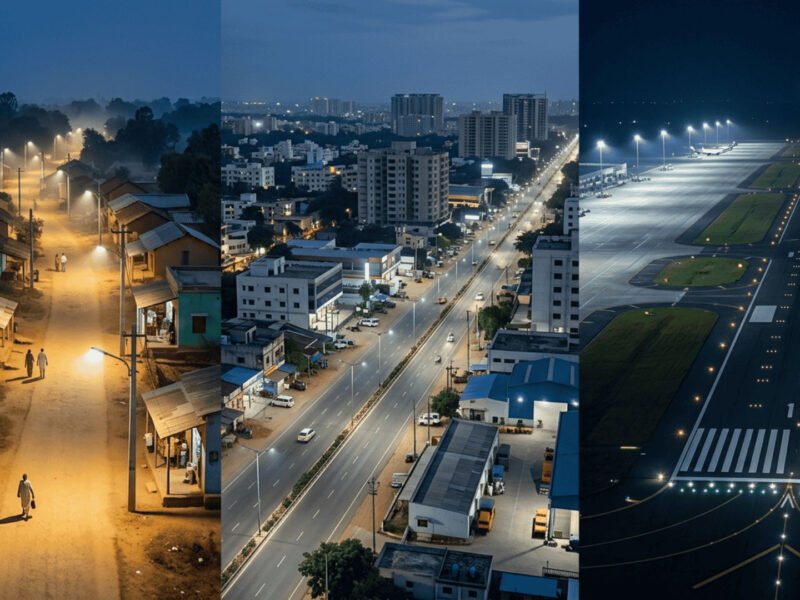

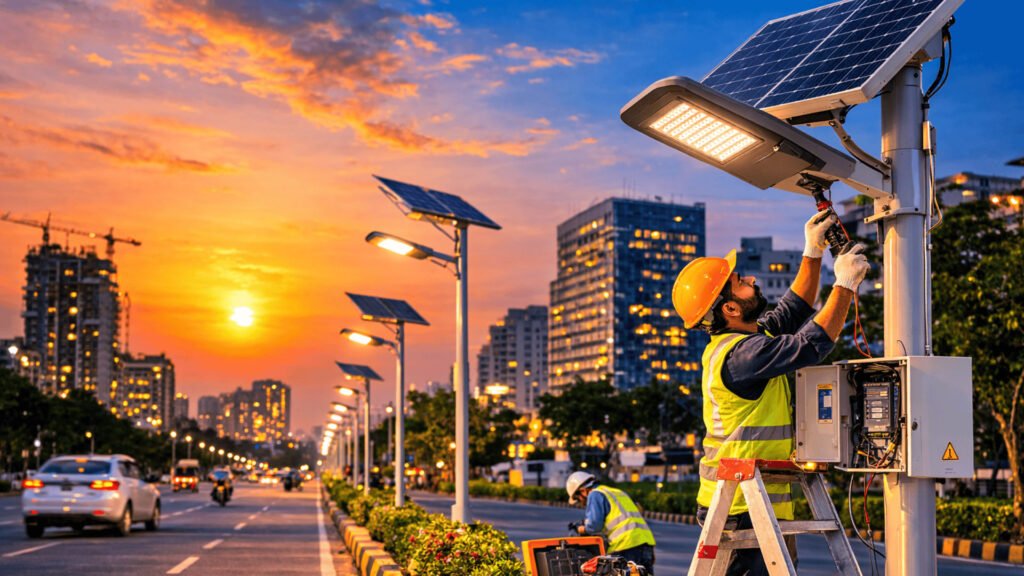
India’s outdoor lighting landscape is undergoing a silent revolution. From rural villages in Rajasthan and Uttar Pradesh to smart city corridors in Pune and Surat, solar street lights are replacing conventional grid-powered luminaires at an extraordinary pace. According to government reports, India installed over 35 lakh solar street lights under MNRE schemes between 2016 and 2024 – and that number is set to triple by 2030.
But here’s the challenge procurement officers, municipal engineers, and project managers face every day: the market is flooded with solar street light manufacturers – some legitimate, some not. How do you separate a truly reliable, MNRE-approved solar street light manufacturer in India from a fly-by-night assembler who imports low-grade Chinese components and rebrands them?
This guide answers that question completely. Whether you’re procuring 50 lights for a village panchayat or 5,000 units for a state highway project, this is the only buyer’s guide you need.
What Is an MNRE-Approved Solar Street Light – and Why Does It Matter?
The Ministry of New and Renewable Energy (MNRE) sets mandatory standards for solar products used in government-funded projects in India. MNRE approval means a manufacturer’s solar street lights have been independently tested and certified to meet minimum efficiency, battery life, and safety parameters.
For municipal buyers and state government projects, purchasing from an MNRE-approved solar street light manufacturer is not just advisable – it is often a legal requirement for subsidy eligibility. Approved manufacturers are listed on the MNRE portal and undergo periodic re-certification.
Key benefits of choosing an MNRE-approved manufacturer:
• Products are eligible for central and state government subsidies under MNRE schemes
• Quality benchmarks are independently verified – not just a manufacturer’s claim
• Reduced risk of product failure in field conditions (India’s extreme heat, dust, and monsoon)
• Compliant for GeM (Government e-Marketplace) tenders and public procurement
Nessa Illumination Technologies has been MNRE-approved for its solar street light range, making it one of a limited number of vertically integrated LED and solar street light manufacturers in India to hold this certification while also manufacturing its own driver electronics in-house.
Types of Solar Street Lights: Integrated vs Split vs Semi-Integrated
When choosing a solar street light system, it’s important to understand the differences between All-in-One (Integrated), Split Solar Street Lights, and Semi-Integrated Street Lights. Each type has its own design, installation method, maintenance requirements, and ideal use cases.
All-in-One (Integrated) Solar Street Lights
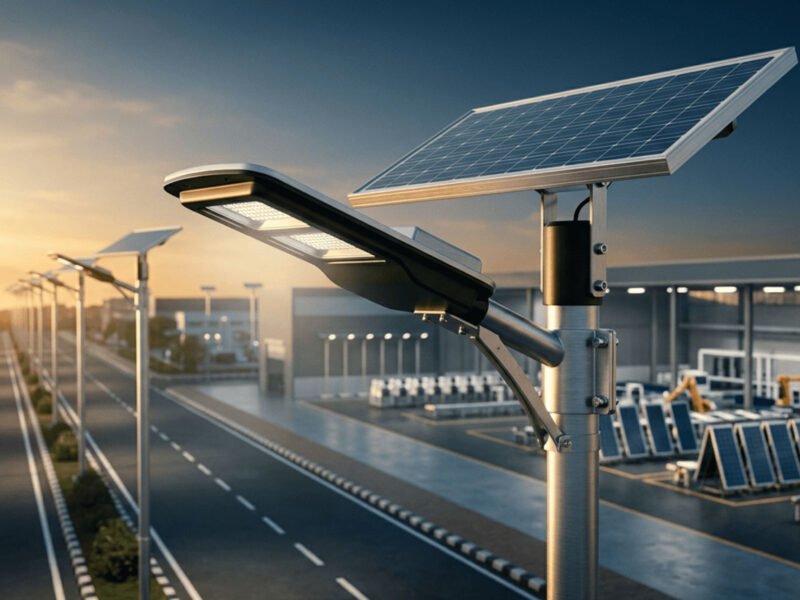
All-in-One solar street lights combine the solar panel, battery, and LED light into a single compact unit mounted on the pole. This design makes installation extremely simple because the system works on a plug-and-play setup with minimal wiring required. Maintenance requirements are also very low, which makes these lights ideal for locations where maintenance access is limited. In hot climates, they perform well when equipped with LiFePO4 batteries, which are more heat-resistant and durable. These lights are commonly used in villages, rural roads, pathways, and small residential streets. In India (2026), the typical cost for these systems ranges from ₹8,000 to ₹22,000 per unit depending on wattage and battery capacity. Most models are eligible for MNRE subsidy programs.
Split Solar Street Lights
Split solar street lights have a separate solar panel mounted on the pole, while the battery and LED light fixture are installed independently. This design requires wiring between the solar panel and the lighting fixture, making installation slightly more complex than integrated systems. Maintenance requirements are moderate, but the system offers one major advantage: the battery can be installed in a shaded or protected location, which improves performance in high temperatures. Because of their higher power capacity and durability, split systems are commonly used on highways, arterial roads, large public infrastructure projects, and stadium lighting areas. In India (2026), the cost of split solar street light systems generally ranges from ₹15,000 to ₹45,000 per unit, depending on system specifications. These systems are also eligible for MNRE subsidies.
Semi-Integrated Solar Street Lights
Semi-integrated solar street lights combine elements of both systems. In this design, the solar panel is integrated with the light head, while the battery is installed in a separate housing on the pole. Installation is moderate in complexity, as the panel still needs to be wired to the battery pack. Maintenance requirements are generally low to moderate, depending on the battery system used. These lights provide good performance and flexibility, making them suitable for urban streets, smart city projects, and municipal lighting applications. In India (2026), semi-integrated solar street lights typically cost between ₹12,000 and ₹35,000 per unit depending on wattage and battery capacity. Like the other systems, most semi-integrated models are eligible for MNRE subsidy programs.
Nessa manufactures all three types under one roof in Ahmedabad – making it one of the few LED and solar street light manufacturers in India to offer a complete integrated product portfolio, from smart solar lights for village roads to semi-integrated street lights for smart city projects.
The 10-Point Buyer’s Checklist: How to Evaluate Any Solar Street Light Manufacturer in India
Use this checklist every time you evaluate a vendor – whether for a government tender, private development, or industrial project
1. MNRE Approval – Ask for the MNRE certificate number and verify it on the MNRE portal. Non-approved products will disqualify your project from subsidies.
2. Battery Technology – Insist on LiFePO4 (Lithium Iron Phosphate) batteries. Lead-acid batteries fail within 2-3 years in India’s heat. LiFePO4 batteries last 7-10 years with minimal maintenance.
3. LED Efficacy Rating – Minimum 130 lumens per watt. Lower-quality LEDs from cheap manufacturers often claim high wattage but deliver poor lumen output. Ask for photometric test reports.
4. Solar Panel Type – Monocrystalline panels offer 20-22% efficiency vs 16-18% for polycrystalline. For space-constrained pole-top installations, mono panels perform significantly better.
5. IP Rating – Minimum IP65 for Indian outdoor conditions (dust and rain resistance). IP66 is preferable for coastal regions and heavy monsoon belts.
6. In-House vs Assembled – A manufacturer who designs and produces their own driver electronics (not just assembles imported components) has dramatically better quality control. Ask directly.
7. Warranty Terms – Minimum 2 years on the complete system; 5 years on solar panel; 3 years on battery. Beware manufacturers who offer warranty only on individual components.
8. Service Network – Does the manufacturer have service centres or authorised partners across India? For government projects, on-site service response time within 72 hours is standard.
9. Reference Projects – Ask for at least 3 completed projects with contact details of procurement officers. Any serious LED street light manufacturer in India will have verifiable references.
10. Smart / RMS Features – For municipal and smart city projects, look for built-in RMS (Remote Monitoring System) capability. Smart solar lights with RMS allow centralised monitoring of energy output, battery health, and fault alerts – reducing O&M costs by up to 40%.
What Wattage Solar Street Light is Best for Indian Roads?
This is one of the most frequently asked questions by procurement officers – and the answer depends entirely on road width, pole height, and spacing. Here is a practical reference guide:
Recommended Solar Street Light Specifications for Different Road Types
When planning a solar street lighting project, selecting the correct wattage, lumen output, pole height, and spacing is essential to ensure proper illumination and energy efficiency. Different types of roads require different lighting specifications depending on traffic density, road width, and safety requirements.
Village Paths or Internal Roads
For small village paths, internal roads, or low-traffic areas, solar street lights with a wattage range of 12W to 20W are usually sufficient. These lights typically produce around 1,500 to 2,600 lumens, providing adequate illumination for pedestrian movement and light vehicle traffic. The recommended pole height is around 5 to 6 meters, with a pole spacing of approximately 15 to 20 meters between each light.
Residential Colonies or Ward Roads
Residential streets and colony roads require slightly brighter lighting to improve safety and visibility. Solar street lights with 24W to 30W capacity are commonly used in these areas. These lights generally provide 3,000 to 4,000 lumens of brightness. The recommended pole height ranges from 6 to 7 meters, while the ideal spacing between poles is around 20 to 25 meters.
Arterial or Collector Roads
Arterial roads or collector roads that carry moderate traffic require more powerful lighting systems. Solar street lights with 40W to 60W capacity are typically recommended for such roads. These lights produce around 5,500 to 8,000 lumens, ensuring better visibility for vehicles and pedestrians. The recommended pole height ranges from 7 to 9 meters, with pole spacing of about 25 to 30 meters.
State Highways or National Highways
For high-speed traffic areas such as state highways or national highways, higher wattage solar street lights are necessary to ensure strong illumination and improved road safety. These roads typically require solar lights with 80W to 120W power output, delivering around 11,000 to 16,000 lumens of brightness. The recommended pole height ranges between 9 to 12 meters, while the spacing between poles should be around 30 to 40 meters.
Industrial Campuses or Logistics Parks
Industrial zones, logistics parks, and large infrastructure campuses require powerful lighting to ensure safety and operational efficiency during nighttime operations. In these areas, solar street lights with 100W to 150W capacity are typically recommended. These systems can produce 14,000 to 20,000 lumens of brightness. The pole height generally ranges from 10 to 14 meters, and the pole spacing is usually maintained between 30 to 40 meters to provide consistent illumination across large spaces.
Nessa’s application engineering team provides free photometric simulation reports for large projects, helping procurement officers specify the exact wattage and pole configuration for their road geometry – a service rarely offered by trading companies passing off as manufacturers.
The key insight: manufacturers who use lead-acid or low-grade Li-ion batteries quote a system lifespan of 3-5 years. Manufacturers using genuine LiFePO4 batteries with a well-designed charge controller – like Nessa’s MPPT-based system – deliver 10+ years of reliable performance. This dramatically changes the true total cost of ownership calculation.
Solar Street Light Cost in India: What Should You Budget? (2026)
Cost transparency is rare in this industry. Here is an honest breakdown of what you should expect to pay in India for a complete, installed solar street light system in 2026:
Cost transparency is rare in this industry. Here is an honest breakdown of what you should expect to pay in India for a complete, installed solar street light system in 2026:
Entry-Level Solar Street Lights (12W – 20W)
Entry-level solar street lights typically cost between ₹6,500 to ₹12,000 per unit at the factory price. When installation costs are included — such as the pole, civil foundation work, and installation labor — the total installed cost generally ranges from ₹10,000 to ₹18,000 per unit. These models usually come with a lead-acid battery, basic LED technology, and a warranty of around 1–2 years. They are commonly used in small rural roads, pathways, or low-traffic areas.
Mid-Range Solar Street Lights (24W – 40W)
Mid-range solar street lights usually cost around ₹14,000 to ₹22,000 per unit ex-factory. Once installation is included, the total installed cost typically falls between ₹22,000 and ₹35,000 per unit. These lights generally feature LiFePO4 lithium batteries, better LED efficacy, and improved durability, along with a 2–3 year warranty. They are widely used in urban streets, residential areas, parks, and townships.
Professional-Grade Solar Street Lights (40W – 80W)
Professional or high-performance solar street lights are priced between ₹22,000 and ₹38,000 per unit at the factory level. After including installation costs, the total price generally ranges from ₹35,000 to ₹55,000 per unit. These systems typically include high-efficacy LED chips, MPPT charge controllers for better energy management, and longer-lasting lithium batteries. Most manufacturers offer a 3–5 year warranty for these products. They are commonly used for highways, industrial zones, and large infrastructure projects.
Smart Solar Street Lights with RMS (Remote Monitoring System)
For projects that require smart monitoring and automation, solar street lights can be equipped with an RMS (Remote Monitoring System). This typically adds an additional ₹2,500 to ₹5,000 per unit, depending on the system features. Smart solar lights allow remote monitoring, smart dimming schedules, fault detection, and performance tracking, making them ideal for smart city and government infrastructure projects.
MNRE-Approved Solar Street Lights (Subsidy Eligible)
If the solar street light system is approved under MNRE (Ministry of New and Renewable Energy) guidelines, buyers may be eligible for government subsidies. The subsidy amount varies by state but usually ranges from ₹2,000 to ₹8,000 per unit. After applying the subsidy, the effective cost of the solar street light installation can be significantly reduced, making solar lighting more affordable for municipalities, panchayats, and public infrastructure projects.
Warning: Beware of quotes below ₹5,000 ex-factory for any solar street light. At that price point, either the LED, the battery, or the solar panel will be below standard – and your project will face failures within 18 months. Multiple state government tenders have been revoked and re-tendered after low-cost procurement failures.
5 Red Flags That Reveal a Fake or Low-Quality Solar Street Light Manufacturer
11. No MNRE certificate number they can share – or the number doesn’t verify on the MNRE portal.
12. The ‘manufacturer’ has no in-house production facility – they are trading companies with factory photos borrowed from Chinese manufacturers.
13. Suspiciously low prices with no explanation of battery chemistry or LED brand.
14. Warranty is offered verbally or only on paper – no written warranty card or after-sales protocol.
15. Cannot provide photometric test reports (LM-79 or NABL-certified) for their LED luminaires.
Why Nessa Illumination Is Among the Top LED Street Light Manufacturers in India
Nessa Illumination Technologies, headquartered in Ahmedabad, has been manufacturing LED and solar street lights since 2008. Here is what sets the company apart from the majority of vendors in this fragmented market:
-
IIT Bombay (Electrical Engineering + M.Tech Microelectronics) & IIM Ahmedabad founded – arguably the strongest technical-academic founder pedigree in Indian LED lighting manufacturing
-
MNRE-approved solar street light range – compliant for government tenders and subsidy schemes
-
In-house driver / controller design – eliminates the most common failure point in solar street lights
-
Full product range: All-in-one solar lights, semi-integrated street lights, solar highmast lights, industrial LED lighting, architectural LED lighting, commercial indoor and outdoor lighting, airport LED runway lights, and RMS remote monitoring systems
-
Exports to 20+ countries including Zambia, Ethiopia, France, Finland, Sri Lanka, and Nepal – validating product quality at international standards
-
100% Made in India – qualifying for government’s Make in India procurement preference
-
Service centres pan-India – ensuring warranty commitments are honoured
Rural Lighting Solutions: Choosing the Right Solar Street Light for Villages
Village solar street light requirements are fundamentally different from urban installations. Panchayats and rural development agencies face unique challenges: limited infrastructure budgets, absence of electricians, unreliable roads for maintenance visits, and extreme weather variation from the Himalayas to coastal plains.