
India’s public lighting infrastructure is undergoing its most significant transformation in decades. Smart solar street lights with RMS (Remote Monitoring System) are now the preferred choice for municipal bodies, highway developers, government contractors, and smart city planners across the country. Nessa, an Ahmedabad-based LED lighting and solar street light manufacturer, has been at the centre of this shift – delivering energy-efficient LED lighting and innovative lighting solutions for roads, villages, industrial zones, and airports across India.
What Is a Smart Solar Street Light?
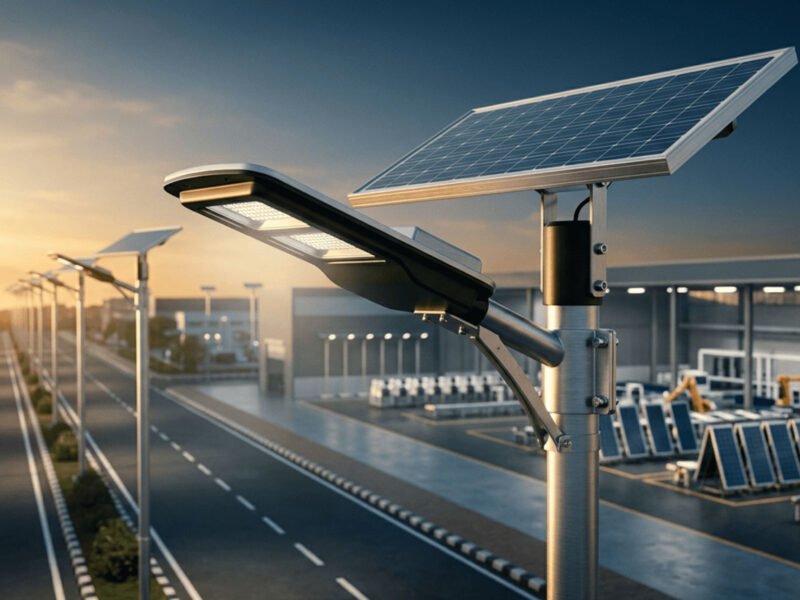
A smart solar street light is a self-powered outdoor lighting system that integrates a monocrystalline solar panel, high-efficacy LED luminaire, LiFePO₄ lithium battery, MPPT charge controller, PIR motion sensor, and an IoT communication module into a single pole-mounted unit. It requires no grid connection, no manual switching, and no dedicated electrical infrastructure.
What distinguishes a smart solar street light from a conventional solar street light is the addition of an RMS module. This module transmits real-time operational data – battery charge level, solar input, lamp status, fault alerts – to a cloud dashboard that project managers can access from any device, from anywhere in India. This combination of autonomous solar power and remote intelligence makes smart solar street lights the most advanced and cost-effective option for India’s streets, highways, and rural roads in 2026.
Why India Is Switching to Smart Solar Street Lights
India’s solar street lighting market is projected to grow from USD 1.07 billion in 2024 to USD 3.54 billion by 2033, at a CAGR of 14.2%, according to IMARC Group. Three forces are driving this growth at scale. The Government of India’s Smart City Mission, DDUGJY rural electrification programme, and MNRE off-grid solar scheme are collectively deploying hundreds of thousands of smart solar street lights every year across urban and rural India.
The financial case is equally compelling. A conventional grid-powered street light costs municipalities between ₹1,500 and ₹3,000 per unit annually in electricity and maintenance charges. Energy-efficient LED lighting powered by solar eliminates this recurring cost entirely. For a municipality managing 10,000 street lights, switching to solar LED saves approximately ₹32 lakh every year – with zero grid dependency. For India’s 600,000-plus villages that still face unreliable electricity supply, village solar street lights are not simply an upgrade – they are the only reliable lighting solution available.
All-In-One vs. Semi-Integrated Solar Street Light: Which Should You Choose?
The choice between an all-in-one and a semi-integrated solar street light is one of the most important decisions in any outdoor lighting project, and the answer depends entirely on application requirements.
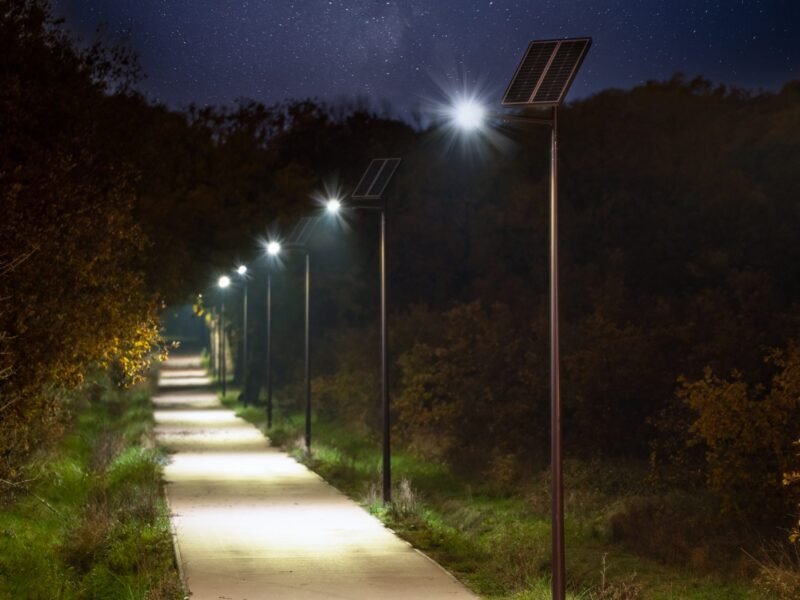
An all-in-one solar street light houses the solar panel, LED luminaire, battery, and controller in a single compact unit that mounts directly on the pole. Installation takes under two hours and requires no specialist electrician – which makes it the ideal choice for village solar street lights, residential colonies, pathways, and community spaces. All-in-one models typically deliver two to three days of battery backup during cloudy weather.
A semi-integrated street light mounts the solar panel separately at an adjustable angle on the pole, allowing for a larger panel size and significantly greater energy harvest. With battery backup extending to three to five days and wattage options ranging from 60W to over 150W, the semi-integrated design is built for national highways, state roads, industrial campuses, and toll plazas. Nessa manufactures both variants – from 24W all-in-one units for villages to 120W semi-integrated systems for highways – with each model BIS and MNRE certified for government tender eligibility.
How RMS Remote Monitoring Works – and What It Saves
RMS, or Remote Monitoring System, is the technology that converts a solar street light from a passive fixture into an intelligent, managed infrastructure asset. Each RMS-enabled smart light carries an IoT node that continuously collects data on solar input, battery percentage, load consumption, and lamp condition. This data is transmitted via 4G or LoRaWAN to a central cloud server, where it is processed and displayed on a web or mobile dashboard in real time.
From this dashboard, a project manager can monitor the live status of every light in an installation – whether that is 50 units in a village or 2,000 units across a highway corridor. Fault alerts are pushed automatically via SMS or app notification when a panel underperforms or a battery degrades. Dimming profiles can be adjusted remotely – for example, set lights to 100% brightness from 7 PM to 11 PM, then dim to 40% until dawn – without a single site visit. Real-world deployments in Rajasthan and Jharkhand show that RMS-equipped installations reduce physical maintenance visits by up to 40% and cut system downtime by 35%, delivering significant long-term savings on large projects.
Industrial LED Lighting, Dimmable Lights, and Energy Efficiency
Industrial environments demand lighting that performs at the extremes. High bay LED lights for warehouses and factories, flood lights for perimeter security, canopy lights for petrol stations and loading bays, and well glass lights for hazardous or wet-area installations all require IP65 or higher ingress protection, a luminous efficacy of at least 150 lm/W, and a total harmonic distortion below 10% to meet industrial electrical standards in India.
Dimmable lights add an important efficiency layer to both industrial and street lighting projects. By reducing output to 30–50% during low-traffic or low-activity hours, dimmable LED systems extend battery backup by up to 60% in solar-powered applications and reduce LED lumen depreciation over the fixture’s lifetime. Nessa’s dimmable LED street lights and industrial luminaires support both time-based and occupancy-triggered dimming profiles, programmable remotely via the RMS dashboard – making them fully aligned with India’s energy-efficient LED lighting mandates under the Bureau of Energy Efficiency (BEE) and ECBC compliance requirements.
Airport LED Lighting, Solar HighMast, and Specialised Applications
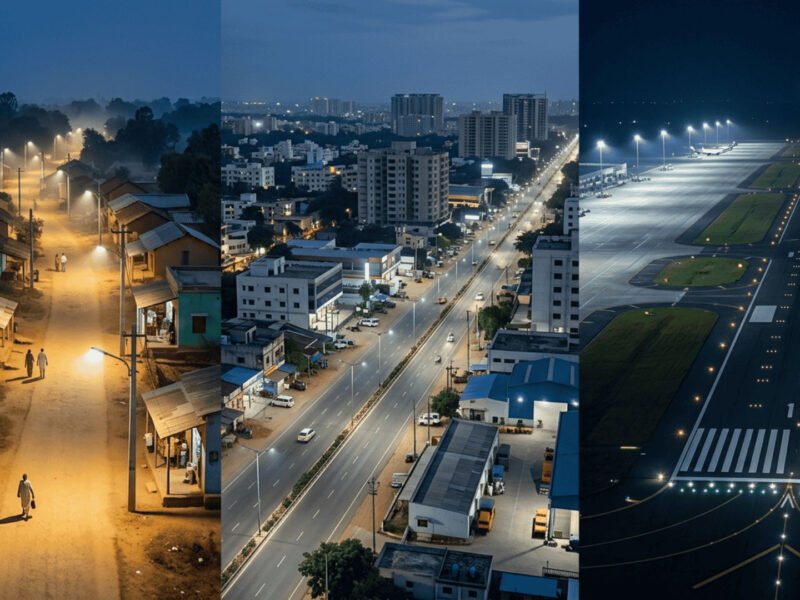
Beyond roads and villages, Nessa’s innovative lighting solutions extend into two specialised but rapidly growing segments. Airport LED lights and LED runway lights must comply with ICAO Annex 14 standards and DGCA guidelines – covering runway edge lights, taxiway centreline lights, apron floodlighting, and perimeter road illumination. With over 100 airports operational and 50 more under development under the UDAN scheme, certified Indian airport lighting solutions are in exceptional demand.
Solar highmast systems – tall structures of 12 to 25 metres carrying multiple high-power LED panels – are the preferred solution for illuminating large open areas including toll plazas, port yards, railway marshalling areas, and mining sites where running power cables across the site is costly or impractical. As one of the few LED light manufacturers in India offering solar highmast alongside the full range of smart street lighting and industrial LED products, Nessa provides project teams with a single, certified manufacturing partner from village pathway to airport runway.
Frequently Asked Questions
What is a smart solar street light?
A smart solar street light is a self-contained, grid-independent lighting system powered by a solar panel and lithium battery, equipped with an IoT-enabled RMS module for real-time remote monitoring, fault detection, and dimming control via a cloud dashboard.
What does RMS mean in street lights?
RMS stands for Remote Monitoring System. It is a cloud-connected platform that tracks the live status, energy output, battery health, and fault conditions of every light in an installation, enabling remote management and predictive maintenance without site visits.
Which solar street light is best for Indian villages?
For Indian villages, an all-in-one solar street light with a LiFePO₄ battery offering three to five days of backup, IP65 rating, motion sensing, and BIS/MNRE certification is the most reliable and low-maintenance choice.
How long do solar street lights last in India?
High-quality solar street lights with LiFePO₄ batteries and monocrystalline panels last eight to twelve years under Indian climatic conditions. The LED luminaire is rated for 50,000 hours of operation.
Nessa is an Ahmedabad-based LED lighting and solar street light manufacturer delivering smart solar street lights, semi-integrated street lights, solar highmast systems, industrial LED lighting, airport lighting solutions, and RMS-enabled smart light infrastructure across India. All products carry BIS and MNRE certification and are backed by a minimum three-year warranty with nationwide project support.
Contact Nessa for bulk pricing, government tender specifications, and a free project consultation at nessa